JFEW’s belief in the paramount importance of women’s education and our sensitivity to the needs of immigrants, low-income and first-generation college students are rooted in our historical experience and inspire all we do.
The Beginning
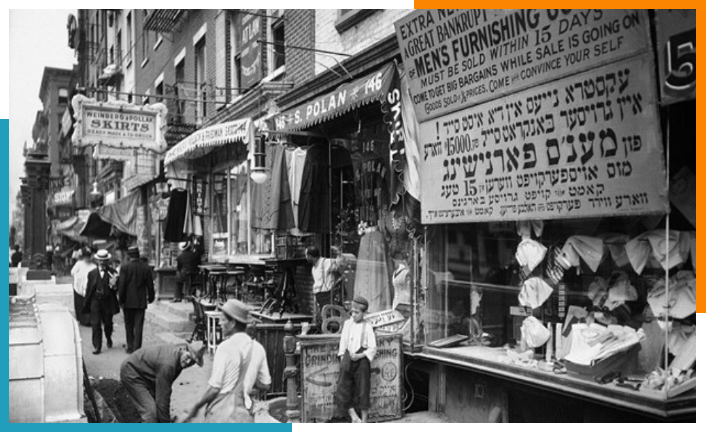
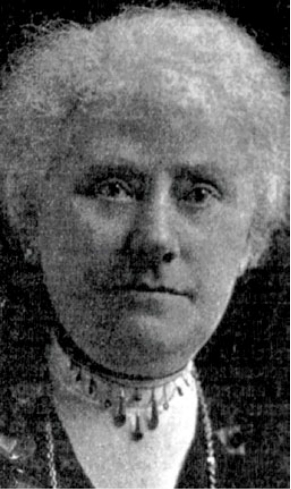
During the late nineteenth century, New York City found itself transformed by an influx of Eastern European immigrants. In 1880, the Louis Down-Town Sabbath School was founded by Minnie Louis to assist the daughters of the city’s poor Jewish families. As one of the first Jewish social welfare organizations established in New York, the school sought to combine formal instruction with the practical knowledge of self-care and hygiene, made necessary by the realities of urban life. Beyond the clothing and refreshments the school distributed, significant emphasis was placed on the promotion of self-respect and ambition.
A Vocational School
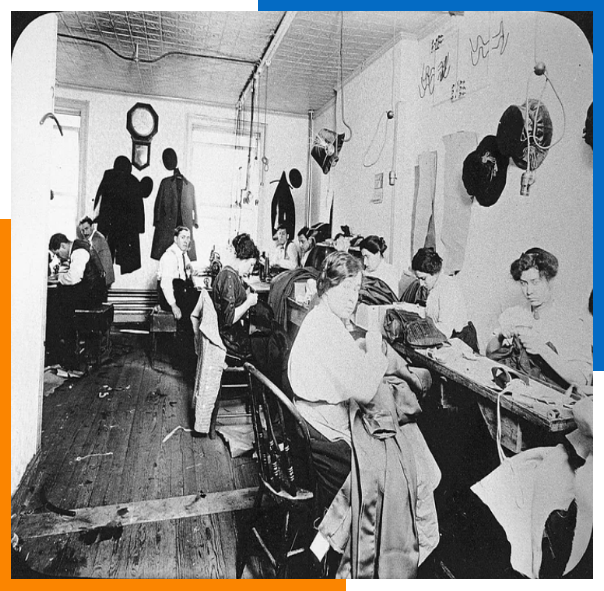
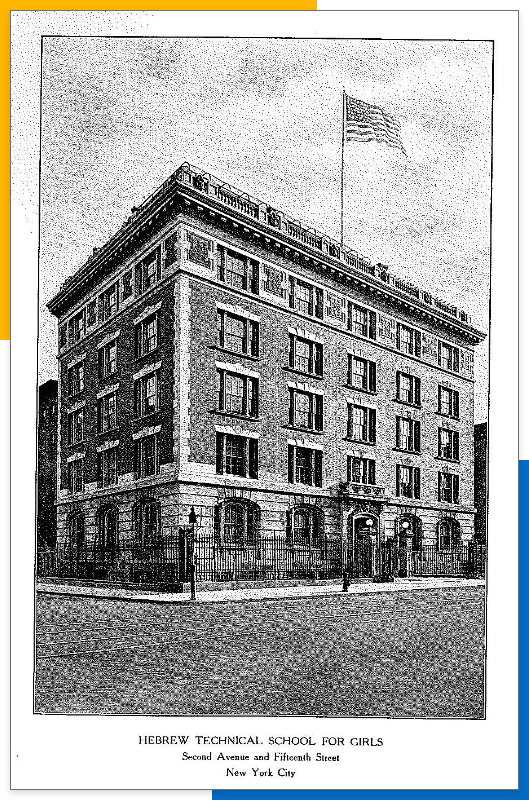
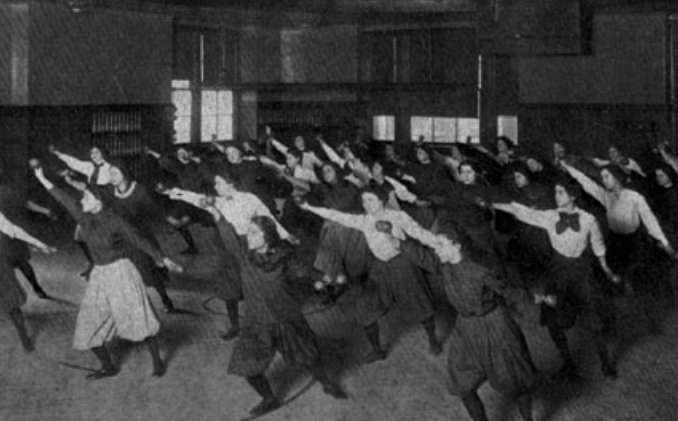
Only a few years after the Sabbath School opened, Louis wanted to address the girls’ future more directly. A “daily school” for girls 14 to 16 supplemented the work of the Sabbath school by providing technical training in areas such as sewing, bookkeeping and typing. In establishing the Hebrew Technical School for Girls, known fondly as “Hebrew Tech,” the hope was that women would acquire skills which would enable them to find steady work that could assist their families and hasten the integration process. By the beginning of the twentieth century, the school had earned a selective reputation, turning away two-thirds of its applicants in 1903. Due to the high degree of interest, the board decided to expand the school and build a modern, five-story facility. The new building’s library, gymnasium and range of appliances motivated the Hebrew Standard to distinguish it as “the best equipped technical school for girls in the United States.” Mark Twain and U.S. presidents Grover Cleveland and William Howard Taft all visited the school.
A Foundation
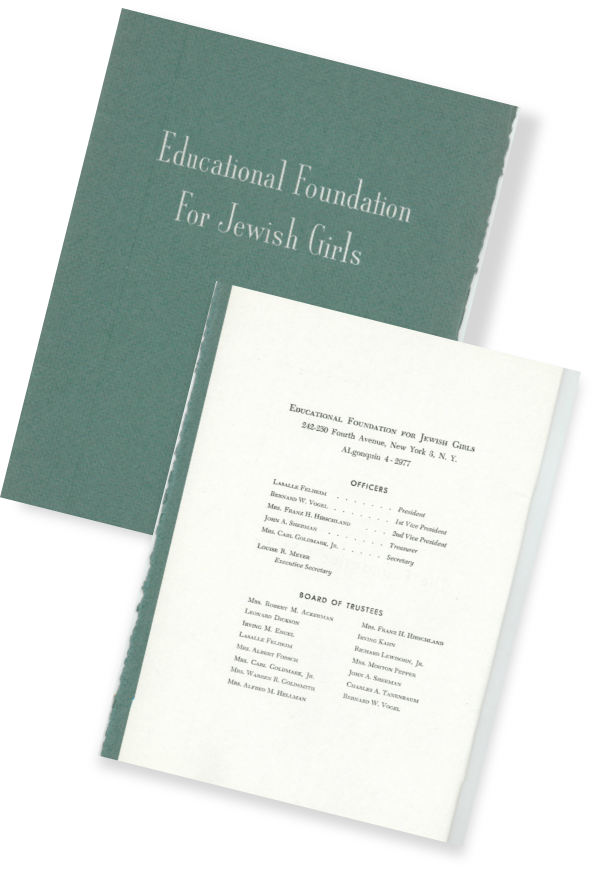
While the Hebrew Technical School for Girls had been innovative and successful, a new network of vocational public schools created by New York City emerged as better equipped to adapt to changing industrial developments. In 1932, Hebrew Tech closed its doors, eventually selling the building to the Board of Education. Two years later, as Hebrew Tech’s board considered its options, its members chose to use the funds acquired from the sale to launch a foundation which would provide scholarships and financial assistance to talented women in need. In 1939, the Educational Foundation for Jewish Girls was officially formed to help Jewish women enter and succeed in education.
Broadening Our Mission
By the late 1940s, women’s employment opportunities were expanding. As the need for women trained at the university level increased, the Foundation’s funding began to shift primarily to college undergraduates. In 1964, the board reconsidered its choice to support only Jewish women and broadened the scope of its scholarship programs to include women of all backgrounds. As women began to enter graduate school in higher numbers in the 1970s and ’80s, the Foundation added graduate funding to its mission. In 1976, following changes in the status of American women, the Foundation transformed itself once again to reflect the times, becoming the Jewish Foundation for Education of Women. By the 1990s, having provided direct financial assistance to over 8,000 women, JFEW began to create partnerships with community-based organizations and with schools to help administer its scholarships.
Campus Partnerships
and Research
Today, JFEW partners with colleges, universities and community-based organizations who share our commitment to women’s educational and professional advancement. We have a particular focus on public institutions, as the greatest drivers of economic mobility. Working across New York State, we support more than 400 students a year through scholarships, paid internships, dedicated advising, professional development and emergency grants. We also address systemic issues through research on basic needs insecurity, student-parents, campus culture for low-income students and other topics.
Timeline of JFEW’s History
Aspiring Women
JFEW from 1880–2024
The history of JFEW traces an arc from 1880 to the present. Our name and programs have evolved along with social attitudes and opportunities for women, but our focus has been constant: helping women with financial need meet their education and career goals.
JFEW works at the undergraduate level in partnership with schools and community groups. Programs support women studying across the disciplines and professions, from health sciences to public policy to criminal justice.
1880
1880
Minnie Dessau Louis founds the Louis Downtown Sabbath School on New York’s Lower East Side to help immigrant girls from Russia adjust to American life. To teach them a trade, she opens the Hebrew Technical School for Girls in 1885 (“Hebrew Tech”) with a vocational curriculum focusing on the domestic arts.
1880
A dramatic immigration of Eastern European Jews to the United States begins. By 1914, over 1.8 million have arrived in New York City, many settling on the Lower East Side.
1890
The National American Woman Suffrage Association is formed to promote voting rights for women.
1900
1904
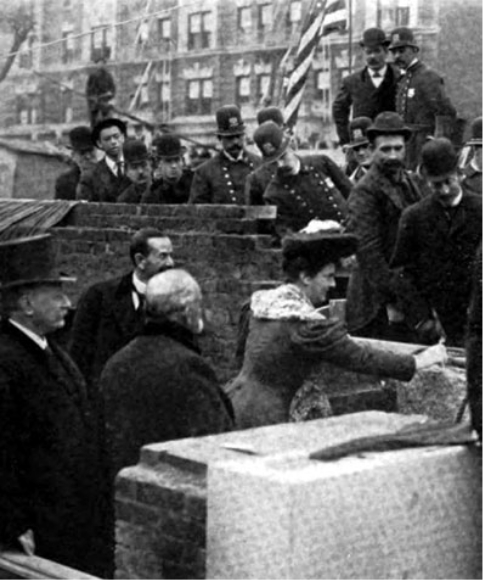
Hebrew Tech breaks ground on a five-story building at 2nd Avenue and 15th Street. Former First Lady Frances Cleveland lays the cornerstone. As office work becomes a respectable employment option for women, the curriculum expands to include secretarial skills.
1901
Mark Twain advocates for women’s right to vote at Hebrew Tech’s Annual Meeting.
1903
The Women’s Trade Union League is formed to support women’s efforts to organize and eliminate unhealthy working conditions.
1916
Louis D. Brandeis, born to immigrant parents, is appointed an Associate Justice on the Supreme Court of the United States. He is the first Jewish Supreme Court Justice.
1920
1932
As public school curriculum expands to include vocational training, Hebrew Tech redefines its mission and restructures as a foundation. The New York City Board of Education assumes ownership of the Hebrew Tech building and operates it today as a public school.
1920
Congress passes the 19th amendment, which grants 26 million women the right to vote.
1933
Jewish community leaders organize rallies across the United States to protest Nazi persecution in Europe. Their efforts fail to affect American policy.
1940
1940
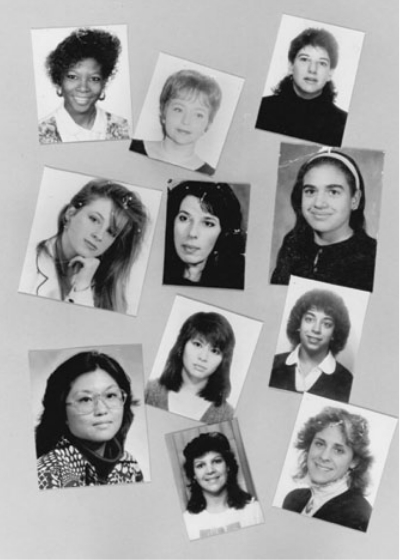
Increasingly, college is an important work credential. Renamed the Educational Foundation for Jewish Girls, the Foundation uses proceeds from the Hebrew Tech building to provide scholarships and loans. Many recipients become the first in their families to pursue higher education.
1950
As more professions – medicine, law, academic – open to women the Educational Foundation for Jewish Girls expands its support to include graduate school.
1941
The participation of women in the workforce more than doubles during World War II. By 1945, that number declines as women give up their jobs to returning male veterans.
1955
Rosa Parks sparks the civil rights movement and later inspires the women’s movement by refusing to yield her seat on an Alabama bus.
1960
1964
Embracing a Jewish imperative and goals of the civil rights movement, the Foundation becomes nonsectarian and changes its name to the Jewish Foundation for Education of Girls.
1969
71-year-old Israeli Foreign Minister Golda Meir, who grew up in the United States, assumes the post of Premier, becoming the world’s third female Prime Minister.
1974
The Women’s Educational Equity Act (WEEA) is one of several landmark laws passed by Congress, including the 1972 “Title IX” Act, outlining federal protections against discrimination by sex in education.
1980
1976
Recognizing that college-bound women are not “girls,” and that its recipients have long included older women, the Foundation assumes its current name: Jewish Foundation for Education of Women (JFEW).
1980
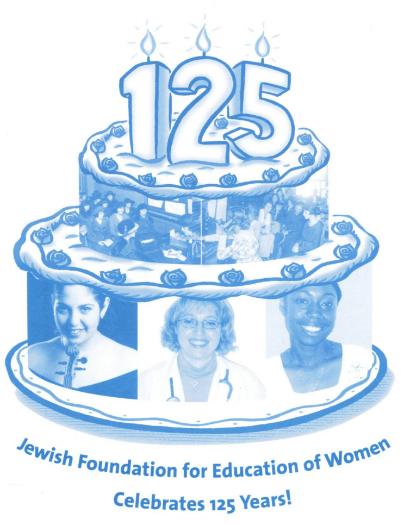
Following decades of funding education to help women launch careers, JFEW adds new programs to help restart careers and support recent immigrants from the Soviet Union whose professional credentials are not recognized in the United States. The Foundation celebrates its 100th birthday.
1982
For the first time, women begin to surpass men in the number of college degrees conferred nationally.
1991
The Department of Labor convenes the Glass Ceiling Commission to investigate barriers to advancement by women and minorities in key sectors of the United States economy.
1994
Judith Rodin is the first woman president of an Ivy League University when she becomes President of the University of Pennsylvania.
2000
2008
Recognizing that more than a check is necessary to help women achieve their educational and career goals, JFEW shifts its primary grant strategy to partner directly with schools, combining scholarship support with internships and special programming for professional development.
2011
JFEW launches new cohort-based programs on CUNY and SUNY campuses, affirming its commitment to public education in New York State.
2012
Women now outnumber men in the workplace. They also earn nearly 57% of all bachelors’ degrees and more than half of all masters’ degrees and doctorates.
2015
JFEW begins to fund research and advocacy projects that address systemic issues impacting JFEW Scholars and students like them.
2020
2020
JFEW creates Covid emergency fund to support Scholars facing unparalleled economic and personal challenges during the pandemic.
2024
JFEW expands its focus beyond senior colleges to address the needs of women in community colleges.
2020
The Covid pandemic causes massive disruption in the US labor market, disproportionately impacting women in the workforce, particularly those in low-wage jobs.
College applications and enrollments plummet, especially at broad access colleges and universities that serve first-generation and low-income students.
2022
Justice Ketanji Brown Jackson is the first Black woman to be appointed to the Supreme Court. Claudia Goldin is the first solo woman to be awarded the Nobel Prize in Economics, for her work on women and pay inequity.